


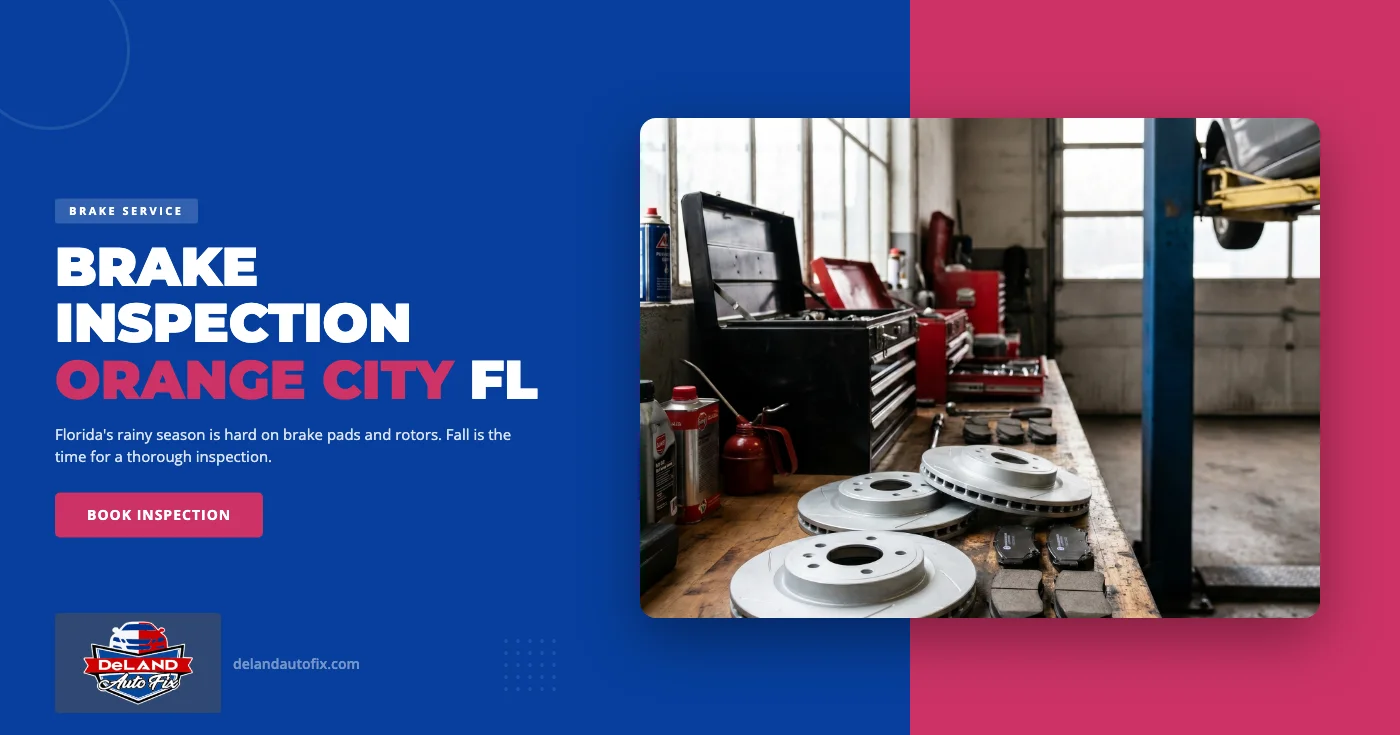
Florida's rainy season punishes a brake system in ways northern manuals never account for. Afternoon downpours flood the roads along Saxon Boulevard and Enterprise Road, standing water sits at intersections for hours, and the humidity keeps everything under the wheel arches damp for days at a stretch. Most drivers pay attention to the parts they can see — tires, wipers, the battery — while a quieter kind of wear builds up on the rotors and pads with every wet commute.
At DeLand Auto Fix, we're the local shop drivers across Orange City, DeLand, DeBary, and Deltona rely on for straightforward, expert work. We book brake repair Orange City FL daily out of our Woodland Boulevard bay, and every fall we see the same pattern: brakes that felt fine in April start showing rust, glazing, and pad thinning right around now. This guide covers what Central Florida's rainy season does to your brakes, the warning signs to catch this fall, and why brake repair in Orange City, FL is one of the smartest moves before holiday travel season.
How Florida's Rainy Season Accelerates Brake Wear in Orange City
Iron brake rotors are essentially raw metal spinning in the open air. Under normal dry conditions, a thin protective film of pad transfer material builds up on the rotor face and slows the pace of corrosion. Central Florida's rainy season strips that film off faster than most drivers realize. Every drive through a wet intersection along Highway 17-92 dumps water on the rotor face, and the first few braking events on a fresh coat of moisture scrape the transfer film away before it can rebuild.
Coastal-Florida conditions accelerate rotor corrosion dramatically compared to drier climates. Iron rotors form a thin oxide layer within hours of rain or overnight humidity, and while the top layer of light rust wipes off in the first few brake applications, the deeper pitting it leaves behind stays permanent. Over a rainy season, that surface roughens, pad wear picks up, and the flat mating surface every brake system depends on starts to disappear.
The problem compounds when a vehicle sits. A car parked overnight after a rainy commute develops a light rust rim on the rotor where the pad was resting. First-morning brake applications knock some of that rust off — but not all of it, and not evenly. Over hundreds of humid nights across a summer, the wear pattern becomes uneven, and pulsation you feel through the pedal is often the first symptom. Vehicles that spend the summer sitting outside in Orange City frequently show more brake wear than higher-mileage vehicles that stayed inside a garage.
Warning Signs Your Brakes Need Attention After a Wet Summer
Brakes rarely fail without warning. They give you weeks of hints before something goes seriously wrong — small changes in feel, sound, and behavior that most drivers learn to tune out. Here's what to watch for as summer turns to fall:
- Squealing or squeaking on the first few stops of the day. Many pads have a metal wear indicator that starts to scrape the rotor as the friction material approaches its minimum thickness. If the noise fades after a few miles, it may be light overnight rust. If it stays after the brakes warm up, it's a wear-indicator call for service.
- Grinding or metallic scraping. This is pad backing plate against rotor, and it means the friction material is gone. Continuing to drive on a grinding brake ruins the rotor, the caliper, and often the wheel bearing in the same corner.
- A soft or spongy pedal. A firm pedal is the sign of a healthy hydraulic system. If the pedal sinks farther toward the floor than it used to, or feels squishy on the first press, moisture has likely gotten into the brake fluid — a fast track to caliper corrosion and reduced stopping power.
- Pulling to one side while braking. A stuck slider pin, seized caliper piston, or corroded brake hose on one wheel makes the vehicle wander under braking. Humidity accelerates every one of those failure modes.
- Pulsation through the pedal or steering wheel. This is the fingerprint of uneven rotor wear. Rust deposits, warped rotors from repeated hot-then-cold cycles, and glazed pads all produce a shudder that shows up strongest during moderate braking from highway speed.
- Longer stopping distances in the wet. As pad thickness drops below about 4mm, the pad's ability to push through the water film on the rotor drops with it. A wet stop that used to feel confident becomes noticeably longer — often the first hint the driver notices before any noise appears.
- Dashboard brake warning light. Modern vehicles monitor pad thickness and fluid level. A dashboard warning is never a suggestion — it's the system telling you an inspection is overdue.
Any one of these is worth a brake check. Two or more together means it's time to book service before a small problem turns into a rotor and caliper replacement.
The Impact of Heat and Humidity on Brake Rotors and Pads in Central Florida
Brake systems are engineered around a delicate thermal balance. Every time you slow the vehicle, kinetic energy converts to heat in the rotor and pad, and that heat has to bleed off into the air before the next brake application. In cool, dry climates, the rotor cools cleanly between stops. In Central Florida, the numbers stop working the same way.
Ambient temperatures in the low nineties combined with humid air that holds heat like a blanket mean rotors take longer to shed the heat from each stop. On a stop-and-go commute from Orange City into Orlando, rotor temperatures can climb past 500°F and stay there through repeated braking events. Above roughly 600°F, the pad's friction material begins to break down — a condition called "pad glazing" — leaving a hard, glassy layer on the pad face that dramatically reduces braking effectiveness. Once a pad glazes, no amount of driving will restore it; the glazed material has to be resurfaced or the pad replaced.
Humidity attacks the system from the other direction. Brake fluid is hygroscopic — it absorbs moisture from the air, and Central Florida's saturated air ambient pushes moisture into the fluid faster than northern climates do. As manufacturer technical bulletins from Wagner Brake and other brake OEs note, brake fluid that starts at 3% moisture will typically double to 6% within two years in a humid climate, and once fluid moisture crosses about 3%, the boiling point drops enough that hard braking can cause a spongy pedal — the fluid literally boils inside the caliper.
The other victim of humidity is the caliper itself. Slider pins seize when their protective grease dries out and moisture gets in. Piston seals stiffen and leak. Copper brake lines corrode from the outside and eventually crack. Every one of those failures is far more common in a Florida vehicle than a similar model driven in Arizona or Colorado — and every one is easier to catch on a routine inspection than to fix after a roadside failure.
Brake Inspection Checklist: What DeLand Auto Fix Looks For
A proper brake inspection is more than "look at the pads." Here's what we check on every vehicle that comes in for a brake service:
- Pad thickness at all four corners. We measure the friction material with a digital gauge and compare against the manufacturer's minimum. Any pad below 4mm gets flagged; anything below 3mm is service-now.
- Rotor thickness and runout. We measure the rotor against its minimum thickness spec (stamped on the rotor edge) and check for lateral runout with a dial indicator. A rotor thinner than spec or warped past 0.003" of runout is a replacement.
- Rotor surface condition. Deep scoring, heat cracks, hot spots (dark discolored patches), or heavy pitting mean the rotor is compromised and should be replaced rather than resurfaced.
- Caliper function. We check that the piston retracts cleanly, the slider pins move freely, the boots are intact, and there's no fluid weeping from the caliper body. A dragging caliper doubles pad wear on that corner and cooks the fluid.
- Brake fluid moisture content. A refractometer or electronic moisture meter tells us whether the fluid is still within spec. Anything above 3% moisture calls for a full flush and refill.
- Brake fluid level and color. A dropping level with no visible leak often points at pad wear (the caliper piston has moved out) or a hidden leak inside the caliper. Dark, murky fluid means it's overdue regardless of moisture reading.
- Hoses and hard lines. Rubber hoses swell and crack as they age; hard lines pit and corrode. We inspect from the master cylinder to each caliper and flag any weakness before it becomes a leak.
- Parking brake operation. On rear-disc vehicles, a rarely-used parking brake often seizes in humid climates. We test operation and adjust the cable if needed.
- ABS sensor and wiring inspection. Corroded ABS sensors are one of the most common Florida-heat and humidity failures. A quick visual and scan-tool live data check catches problems before the ABS light comes on.
Every finding is documented in a written photo report before we quote a dollar of work. No vague "brakes are bad" invoice, no upsell surprises. Our brake repair service in Orange City, FL is built around exactly this level of documentation.
How Long Do Brakes Last in Florida's Wet Climate?
Brake life is one of the most variable numbers in auto maintenance. A brake pad set marketed as "50,000 miles" can last anywhere from 20,000 to 80,000 miles depending on driving style, terrain, vehicle weight, and climate. Central Florida sits on the shorter end of that range for three specific reasons.
First is the driving pattern. Stop-and-go traffic on I-4 and around the shopping and school corridors uses brakes far more heavily than steady highway driving. A commuter who spends 45 minutes in traffic morning and evening will wear pads out roughly twice as fast as a rural driver logging the same annual mileage.
Second is the terrain. Central Florida's flat roads mean drivers rarely use engine braking on downhill grades — the way mountain-state drivers save their brakes with a lower gear. Every stop in Orange City is a full braking event, and pad wear is proportional to how often the pads have to convert kinetic energy to heat.
Third is the climate. Between rotor corrosion from humidity, pad glazing from repeated hot-cold cycles, and fluid degradation from moisture absorption, every component in the system ages faster than it would in a dry, cool region. Many Central Florida vehicles benefit from a brake inspection every 6,000 to 7,500 miles rather than the 12,000-mile interval a factory manual quotes for "normal" conditions — because Florida driving qualifies as severe service under nearly every automaker's own definition.
As a rough guideline for our region: front pads on a typical sedan or crossover last 25,000 to 40,000 miles, rear pads run 35,000 to 50,000 miles, rotors typically last two pad cycles if driven and serviced well, and brake fluid should be flushed every 2 to 3 years in this humidity. Trucks, SUVs, and vehicles used for towing wear brakes faster; European vehicles with performance-oriented brake systems (BMW, Audi, Mercedes) often go through pads even quicker.
Why Fall Is the Best Time for a Brake Inspection in Orange City
September, October, and November are the brake-service sweet spot in Central Florida, and there are three practical reasons why.
First, the rainy season has done its damage. Rotor corrosion, pad glazing, caliper stiffness, and fluid moisture absorption have all had a full summer to accumulate, so a fall inspection gives us the clearest possible read on how the system held up. A brake check in April tells us what a mild winter and spring did — meaningful, but far less predictive of trouble than a check right after months of daily rain, humidity, and heat.
Second, cooler ambient temperatures make diagnosis more reliable. A brake that pulses on a 95°F afternoon might feel smooth on a 75°F morning, masking the underlying rotor problem. Fall temperatures give us a middle-ground read where marginal components show themselves clearly on the road test and on the scan tool for ABS and traction-control fault codes.
Third, fall service prepares your vehicle for holiday travel. Central Florida families put serious miles on their vehicles from Thanksgiving through New Year's — trips north to see family in Georgia and the Carolinas, day drives to Ocala and Tampa, or shuttle runs to Orlando theme parks and the airport. Servicing the brakes in October means you head into that season with fresh pads where needed, straight rotors, clean fluid, and a documented inspection. We often pair the fall brake inspection with an oil change and maintenance visit so we can catch small issues across brakes, cooling, and fluids in one appointment. Our auto diagnostics team is happy to walk through any warning lights or symptoms before recommending a dollar of service.
Our owner is a BMW Certified Technician Specialist, so European brakes get the same expert attention as domestic and Asian imports. Every brake service is backed by our 3-year / 36,000-mile TechNet nationwide warranty, and the free 15-minute diagnostic is genuinely free with no obligation. Our free valet drops you off at home or work in Orange City, DeBary, Deltona, or DeLand, and our free second-opinion policy means that if another shop has quoted brake work, we'll give you a straight read on whether it's actually needed. Se habla español, and we're proud to be your local, family-owned dealership alternative for reliable brake repair before the next rainy season.