
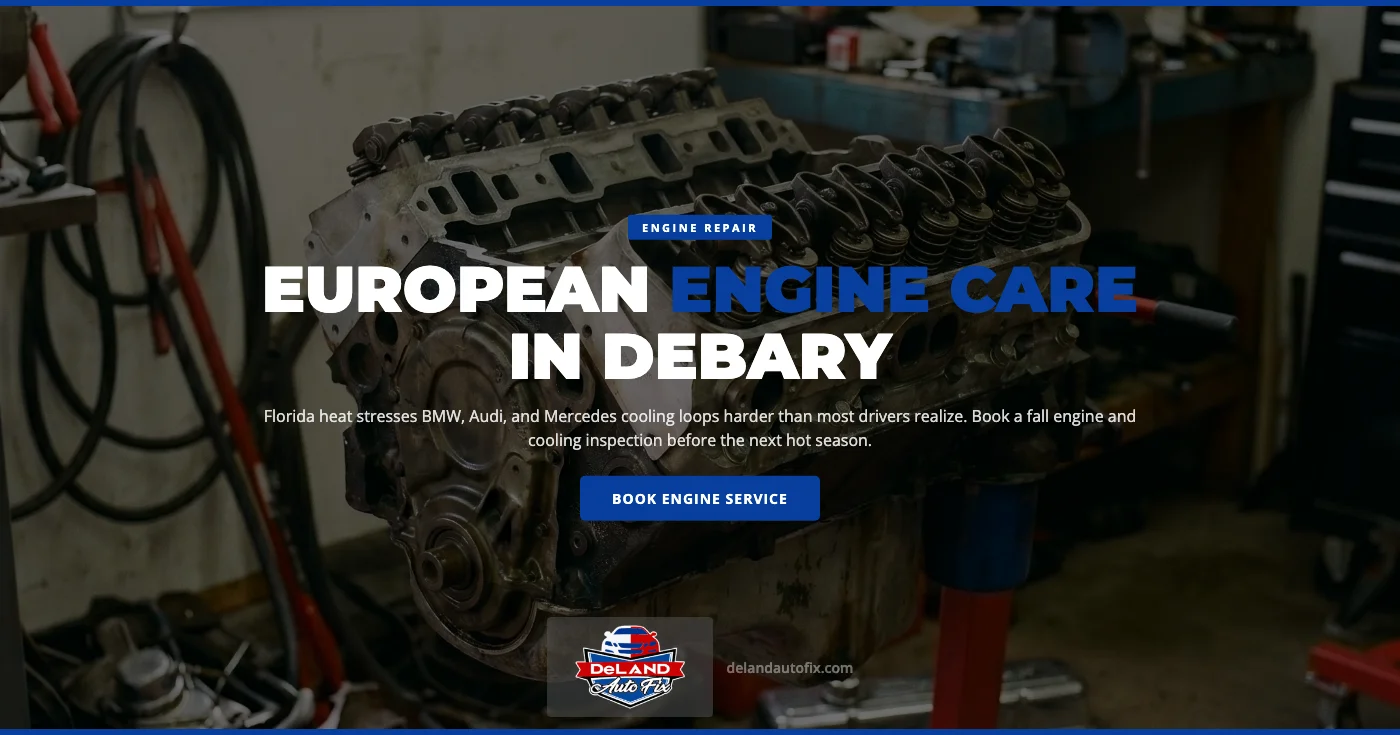
Florida summer punishes a European engine in ways northern service manuals were never written for. Afternoon highs sit in the low nineties, engine bays climb past 220°F in traffic on Highway 17-92, and humidity keeps cooling systems working overtime long after sunset. BMW, Audi, Mercedes, Volkswagen, and Porsche were engineered for European weather — precise and tightly toleranced. Drop one into DeBary's climate for a decade and every one of those tolerances becomes a wear point.
At DeLand Auto Fix, we're the shop DeBary drivers trust for straightforward, expert engine repair in DeBary, FL on European vehicles. Our owner is a BMW Certified Technician Specialist, and we book European engine repair daily out of our Woodland Boulevard bay. This guide covers what Florida heat does to European engines, the warning signs to catch this fall, and the specific issues we see most often on BMW, Audi, and Mercedes platforms across Central Florida.
How Florida's Summer Heat Affects European Car Engines Differently
European engines run hotter by design. BMW, Audi, and Mercedes engineers spec higher operating temperatures than most domestic and Asian counterparts — often 210–220°F versus 195–205°F on a comparable American engine. The reasoning is efficiency: hotter combustion is more complete, and hotter engine oil sheds moisture faster. That works cleanly in Munich or Stuttgart, where the ambient air rarely tops 85°F. It works less cleanly in DeBary in July.
When ambient is 92°F and pavement radiates 130°F back at the engine bay, a European engine designed to hold 215°F has almost no thermal headroom left. Every component in the cooling loop — electric water pump, electric thermostat, plastic expansion tank, aluminum radiator, hoses — works at the top of its rated envelope for months. Rubber seals harden. Plastic thermostat housings crack. Electric water pumps, bolted to the block, cook from the inside out.
Add stop-and-go traffic on I-4 through DeBary and Deltona, and the picture gets harder. Air isn't moving through the radiator at idle, so the electric fans do the entire cooling job — already fighting a heat-soaked bay with radiant loads no European climate ever throws at them. That's why European vehicles that show up at our shop in September often show wear the same platform in a milder climate wouldn't reach for another three or four years.
Warning Signs Your European Engine Needs Attention This Fall
European engines rarely announce trouble the way older domestic engines did. Modern BMW, Audi, and Mercedes powertrains are heavily managed by computers that adjust timing, fuel trim, and boost to mask developing problems as long as possible. By the time the dash warns you, the issue has usually been building for weeks. Here's what to watch for as summer heat backs off:
- Coolant loss with no visible leak. A slowly dropping expansion-tank level with no puddle underneath signals internal cooling failure — a leaking water pump seal, cracked plastic thermostat housing, or early head-gasket weep. On European platforms, coolant loss without a puddle is almost never nothing.
- Temperature gauge climbing above the normal midpoint. European engines should sit rock-steady near center once warmed up. Any drift toward the upper third, especially at idle in traffic, points at a marginal thermostat, failing electric water pump, or airflow problem at the radiator.
- Check engine light with cooling-system codes. Codes in the 2E82, 2E83, or 3111-series (BMW), P0128, P0217 (Audi/VW), or P0480/P0481 (Mercedes fan control) families all point at cooling-loop wear that needs attention before a real overheat lands.
- Heater blowing cold at idle, hot at highway speed. Classic early-stage electric water pump failure — the pump can still move fluid at low load, but the impeller has cavitated or the motor is dying and it can no longer maintain flow when the engine gets hot.
- Coolant changed color. Fresh BMW/MINI G48 is blue. Fresh Audi/VW G12/G13 is pink. Fresh Mercedes coolant is yellow or blue by year. If yours has turned brown, cloudy, or rusty, oxidation has started and cooling passages are being coated with sediment.
- Oil consumption climbing over the summer. Modern European engines burn a little oil by design, but a sudden jump — a quart every 1,500 miles when you used to go 3,500 — traces to valve stem seals or piston rings run near the top of their thermal window all summer.
Any one of these deserves a look. Two or more together means it's time to book engine repair before a manageable job becomes a tow bill.
Common Engine Problems for BMW, Audi, and Mercedes in Central Florida
Every European platform has its own signature Florida-heat failures. Here's what we see most often across the vehicles that come through our doors from DeBary, Deltona, Orange City, and the surrounding communities:
- BMW N54 and N55 electric water pumps. The 335i, 535i, X3, X5, and X6 turbo six-cylinder engines use an electric water pump that consistently fails between 60,000 and 80,000 miles — and Central Florida heat pulls that window forward. The pump can quit without warning, and the sudden loss of circulation lets a heat-soaked engine climb to catastrophic temperatures in under a minute. Industry-standard practice, documented across trade publications like Tomorrow's Technician, is to replace the thermostat at the same time — the labor overlap makes it nearly free.
- Audi and VW EA888 timing chain tensioners. The 2.0T engine in the A4, A5, Q5, Golf R, and Passat is one of the most common European engines in DeBary. Its timing chain tensioner is heat-sensitive, and rattle on cold start after a hot summer is the classic pre-failure signal. A snapped tensioner turns a $600 preventive job into a bent-valve rebuild.
- Mercedes M272/M273 balance-shaft and idler-gear wear. Mid-2000s C-Class, E-Class, and CLK models with these V6 and V8 engines wear the balance-shaft sprocket or idler gear early, and heat accelerates the wear. Rough idle, misfire codes, or a check engine light that keeps returning after clearing is the pattern.
- VW/Audi PCV valve failure. The plastic positive crankcase ventilation valve on 2.0T and 3.0T engines becomes brittle in Florida heat and cracks, causing a lean-running code, whistling from the intake manifold, and oil consumption. It's a $200 part that costs $1,200 in downstream damage if left alone.
- BMW oil filter housing gasket leaks. The rubber gasket sealing the plastic oil filter housing to the aluminum block dries out in sustained heat and starts leaking oil onto the alternator or belt. It's the number-one BMW oil leak we see on N20, N26, N52, and N55 engines that have spent a summer in Central Florida.
The pattern across every one is the same: Florida summer heat exposes weak points in a design that would age slower somewhere cooler. Catching the pattern early is what keeps engine repair affordable.
Why Cooling System Maintenance Matters in DeBary's Climate
Of all the systems on a European engine, the cooling loop is the one Florida punishes hardest. Coolant that starts the summer bright blue or pink turns brown by September, additive packages break down under sustained heat, and the electric components that circulate it cook from the ambient temperature they sit in. Skip a cooling service on a BMW or Audi in DeBary and the odds of a $2,500 electric-pump-plus-thermostat job before 100,000 miles climb sharply.
Manufacturer coolant intervals were also written for European conditions. BMW's "lifetime coolant" claim assumes a cool climate; in Central Florida we recommend a full coolant flush every 60,000 miles on BMW, Audi, and Mercedes vehicles, and every 40,000 miles on turbocharged direct-injection engines that run hotter still. That interval keeps additives fresh, catches early hose and gasket wear, and lets us inspect the electric pump and thermostat for the specific pre-failure symptoms the platform shows.
DeBary sits on the I-4 corridor between DeLand and Sanford, and daily commutes into Orlando are exactly the high-heat, high-load, long-idle duty cycle that compresses cooling-system life fastest. A vehicle that sees 45 minutes of Orlando traffic morning and evening lives at the top of its thermal envelope all summer. Fall is the right time to service the cooling system after that duty cycle, before the next summer stacks on top of it. Our engine repair service is built around the failure patterns Central Florida drivers see on the platforms we work on every week.
The European Car Engine Inspection Process at DeLand Auto Fix
When a European vehicle comes in for a fall engine check, we run a sequence built around what actually fails in this climate — not a generic multi-point checklist. We start with a free 15-minute diagnostic and a full OBD-II scan across every module the vehicle exposes. On European platforms that means far more than the powertrain module — we pull codes from engine, transmission, chassis, comfort, and body control units so cross-module issues surface (a coolant temperature code paired with a fan speed sensor code tells a very different story than either alone). Every code is documented in writing before we quote a dollar of work.
Next comes a full underhood inspection at operating temperature. We pressure-test the cooling system, inspect the expansion tank and cap for cracking and residue, check every visible hose and clamp, and look for platform-specific early-failure markers — oil filter housing weep on BMWs, PCV whistle on Audis, thermostat housing seepage on Mercedes. Coolant color and freezing point get checked with a refractometer against manufacturer spec, and oil condition and level are inspected while warm.
Deeper diagnostic work uses the right tool for the system — a bore scope through a spark plug hole for direct-injection carbon inspection, an oscilloscope on the water pump control signal, or a full smoke test of the intake tract for vacuum leaks. Our auto diagnostics team uses factory-level scan tools where the platform requires them, so we read live data streams the way a dealer would. Everything is written into a photo-supported report, quoted transparently, and prioritized by urgency — critical first, wear items second, comfort last. No compressed timeline, no upsell surprises.
Post-Summer Engine Checks Every DeBary Driver Should Schedule
For DeBary drivers with a European vehicle, we recommend the following fall service items after a summer of heat, humidity, and heavy driving:
- Cooling-system flush and inspection every 60,000 miles (40,000 on turbo direct-injection engines). Fresh manufacturer-spec coolant, pressure test, hose and housing inspection, water pump and thermostat evaluation. This one service prevents the majority of catastrophic overheats we see in October and November.
- Oil and filter service with a full underhood inspection. European oil intervals often run 10,000 miles, but Florida driving qualifies as severe service on nearly every manufacturer's own definition. We recommend 7,500-mile intervals with OEM-spec full-synthetic oil (BMW LL-01, VW 502.00, Mercedes 229.5, etc.) and a full inspection each visit.
- Cabin filter and engine air filter replacement. Central Florida pollen, dust, and humidity clog European cabin filters faster than any interval the manufacturer prints. A restricted engine air filter also drops fuel economy and raises operating temperature, so it's worth checking every fall.
- Brake fluid moisture test. European brake fluid (DOT 4 LV on most modern BMW, Audi, and Mercedes vehicles) absorbs moisture aggressively in humid climates. If moisture content exceeds 3%, we flush and refill — otherwise braking performance drops and ABS module wear accelerates.
- Transmission fluid check on ZF 8HP, Aisin, DSG, PDK, and 7G-Tronic units. Each has its own fluid and interval, and Florida heat compresses every one. Fall is the right time to pull a sample and check condition.
Every engine repair we perform is backed by our 3-year / 36,000-mile TechNet nationwide warranty. The free 15-minute diagnostic is genuinely free and comes with no obligation — book it, get the report, decide from there. Our free valet drops you off at home or work anywhere in DeBary, Deltona, Orange City, or DeLand, and our free second-opinion policy means that if another shop has quoted European engine work, we'll give you a straight read on whether it's actually needed. Se habla español, and we're your local, family-owned dealership alternative for European auto repair in DeBary that respects your vehicle and your time.